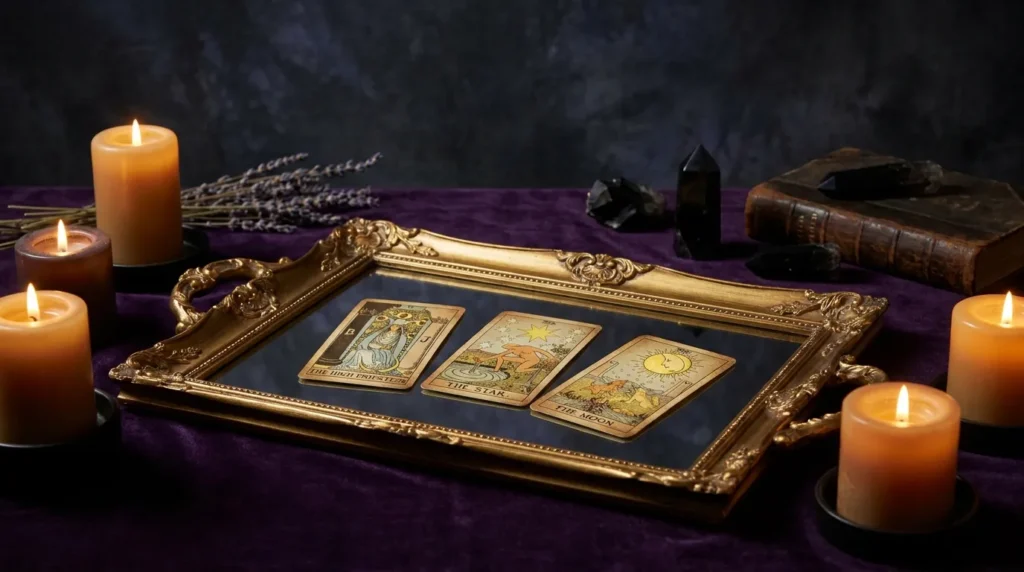

Tarot can help you make a decision, but it should never make the decision for you.
When you feel divided between two paths, the difficulty is not always a lack of information. Sometimes the facts are already available, but fear, hope, attachment, pressure, and conflicting values are all speaking at the same time.
A reflective tarot reading can help separate those voices. It does not reveal a guaranteed outcome or tell you which path fate has chosen. Instead, it gives your question a symbolic form so you can see what may be influencing your choice beneath the surface.
Tarot is a mirror, not a command
It can be tempting to ask a card to carry the responsibility of choosing:
- Should I stay or leave?
- Should I accept this opportunity?
- Should I begin this relationship?
- Should I change direction?
These are real questions, but a card cannot live with the consequences of the answer. You can.
This is why the central principle of reflective tarot is simple:
The card decides nothing.
A card can reveal an image, tension, possibility, or pattern. It can help you notice something you have minimized or avoided. But the final meaning belongs to the conversation between the symbol and your lived experience.
Why decisions become emotionally difficult
A decision can look practical on the outside while carrying a much deeper question inside it.
You may think you are deciding whether to accept a new job, while part of you is actually deciding whether you are allowed to outgrow an old identity. You may think you are deciding whether to end a relationship, while also confronting a fear of being alone. You may think you need more time, when what you really need is permission to disappoint an expectation that was never truly yours.
Tarot can be useful because symbols do not only address the visible options. They can bring attention to the emotional structure surrounding them.
What tarot can reveal around a choice
A reflective reading may help you explore four important layers of a decision.
1. The hidden influence
Every decision is shaped by something that may not be fully visible. It might be an old fear, a need for approval, an assumption about what success should look like, or an emotional attachment to the familiar.
A card does not diagnose this hidden influence. It offers an image through which you can examine it.
A sealed vessel might suggest something you have been containing. A falling structure might bring attention to a plan that no longer feels stable. A traveler at the beginning of a road might reflect genuine readiness—or the temptation to escape before completing what the present is asking of you.
2. The values in conflict
Many difficult choices are not battles between right and wrong. They are conflicts between two values that both matter.
You may value freedom and security. Honesty and harmony. Belonging and independence. Rest and ambition. Loyalty and growth.
A tarot image can help you name which values are pulling in different directions. Once the conflict is visible, the decision becomes more honest. You are no longer pretending that one path contains everything and the other contains nothing.
3. The emotional cost
Every meaningful choice closes at least one door. Even the right decision can contain grief, uncertainty, or discomfort.
Sometimes indecision is an attempt to avoid that emotional cost. By refusing to choose, you try to preserve every possibility. But keeping every door open can become its own form of confinement.
Tarot can help you ask not only, “Which option feels better?” but also, “Which discomfort am I willing to meet in service of what matters?”
4. The conscious next step
A decision does not always need to be solved in one dramatic moment. Sometimes the next honest action is smaller than the final answer.
You may need to gather information, express a boundary, ask a direct question, write down your priorities, test an idea, or give yourself a defined period of reflection.
A useful reading brings you back to what is within your influence now.
Better tarot questions for decisions
Instead of asking the cards to choose an outcome, ask questions that expand your awareness.
- What am I not seeing clearly about this decision?
- Which fear may be influencing the way I view my options?
- What value am I trying to protect?
- What part of this choice belongs to me, and what does not?
- What would I choose if I were not trying to satisfy everyone?
- What information do I still need before acting?
- What conscious step can I take without pretending to know the entire outcome?
These questions do not remove uncertainty. They help you become more present within it.
Guidance versus permission
There is an important difference between using tarot for guidance and using it for permission.
Guidance asks, “What can this symbol help me understand?” Permission asks, “Can I blame the card for what I already want to do?”
You may already have a preference before the reading begins. That is not a problem. The problem begins when you repeatedly draw cards until one appears to approve the answer you wanted.
Reflective tarot does not require you to pretend you are neutral. It asks you to become honest about your preference and curious about what may be shaping it.
Signs you may be giving the cards too much power
Pause and return to your own judgment when you notice yourself:
- repeating the same question until you receive a preferred answer;
- treating one difficult card as proof that something bad will happen;
- asking the cards to reveal another person’s private thoughts as fact;
- avoiding a necessary conversation because the reading feels easier;
- using tarot in place of qualified medical, legal, financial, or psychological guidance;
- feeling unable to make ordinary choices without drawing another card.
A healthy tarot practice should strengthen your relationship with your own discernment, not weaken it.
A simple decision-making ritual
Before beginning a reading, divide a page into three sections.
What I know
Write only the observable facts. Avoid predictions, interpretations, and imagined motives.
What I feel
Name the emotions present without judging them. Fear, excitement, resentment, relief, grief, hope, and confusion can all belong to the same decision.
What I am assuming
Write down the stories you are adding to the situation. What do you believe will happen? What are you afraid others will think? Which conclusion have you treated as certain without testing it?
Then begin your tarot reading with a question such as:
“What hidden pattern deserves my attention, what inner quality can help me meet it, and what conscious step is available now?”
After the reading, return to the page. Notice whether the cards changed the facts, the feelings, or the assumptions. Often, the greatest shift happens in the third section.
What if the reading does not give you a clear answer?
That does not mean the reading failed.
Sometimes clarity is not an immediate conclusion. It is the recognition that you need more information, more time, a firmer boundary, or a conversation you have been postponing.
A card may also reveal that both options contain something meaningful and something difficult. In that case, the reading is not refusing to help. It is refusing to create false certainty where none exists.
Ambiguity can be an honest result.
How PlayTarot approaches a decision
PlayTarot does not place a card in a position called “The Fixed Future.” Its readings move through a different arc: what may be hidden, what the situation is asking you to understand, and what conscious movement is available now.
The cards are then woven into one connected reflection rather than presented as isolated definitions. The purpose is not to deliver a verdict. It is to help you see how the deeper pattern, the inner lesson, and the practical step relate to one another.
The reading ends where your authorship begins.
The choice remains yours
Tarot can slow down a rushed decision. It can reveal a fear hiding beneath logic, a value hiding beneath conflict, or a possibility hiding beneath habit.
But it cannot guarantee that a path will be painless. It cannot remove every risk, predict another person’s behavior, or protect you from the responsibility of choosing.
What it can offer is a more honest mirror.
A good reading does not tell you which life to live. It helps you recognize the voice with which you are choosing it.
Bring your decision to a reflective PlayTarot reading
✨ Ready to explore your own reading? Visit PlayTarot, choose your deck, and begin your inner journey.
📌 Original Content Notice: This article was originally published on PlayTarot Blog . All rights reserved.
The reproduction, copying, or redistribution of this content, in whole or in part, without prior authorization is prohibited. Our articles are created with symbolic research, editorial care, and human review to support a deeper exploration of tarot, self-knowledge, and inner transformation.