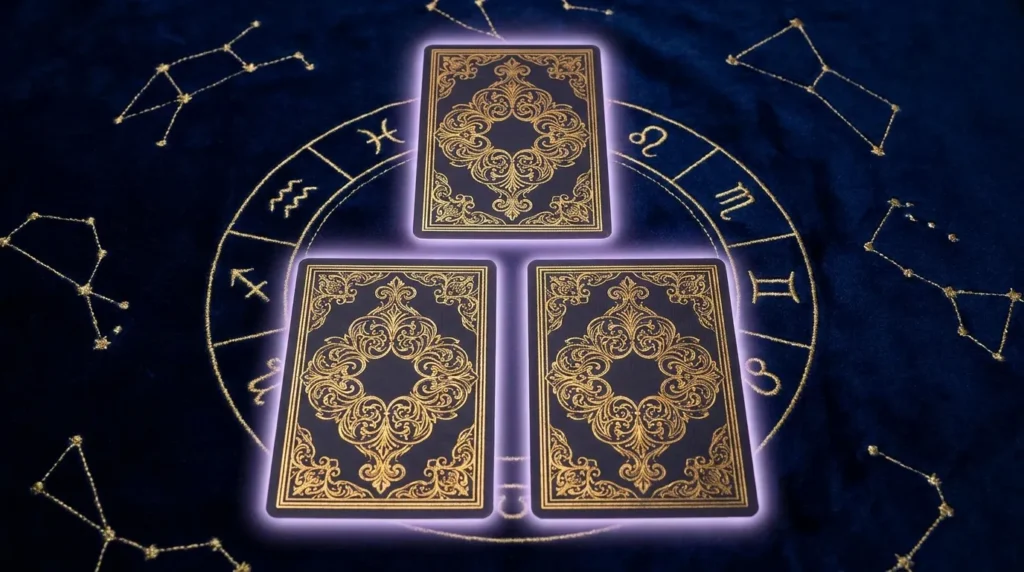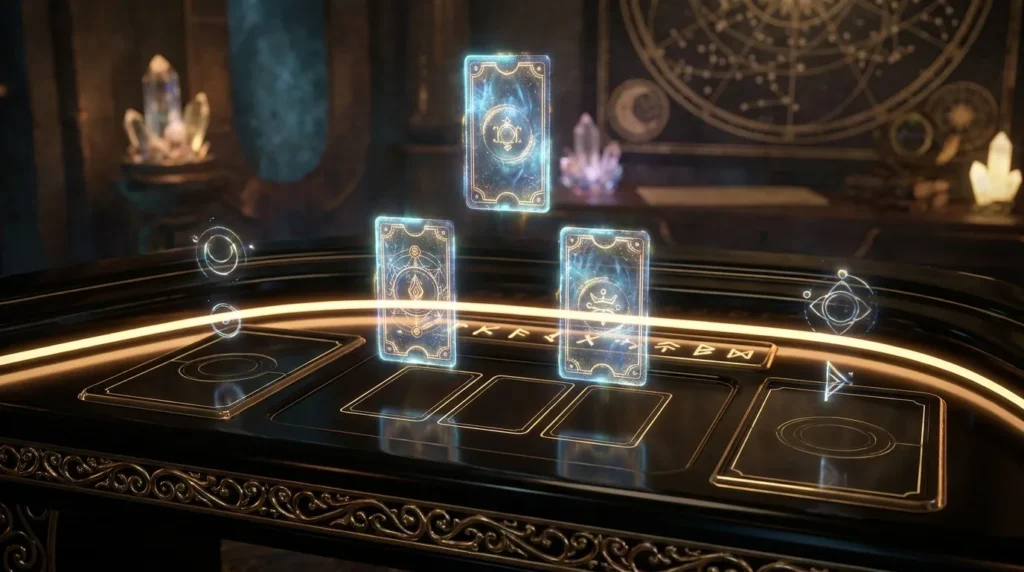
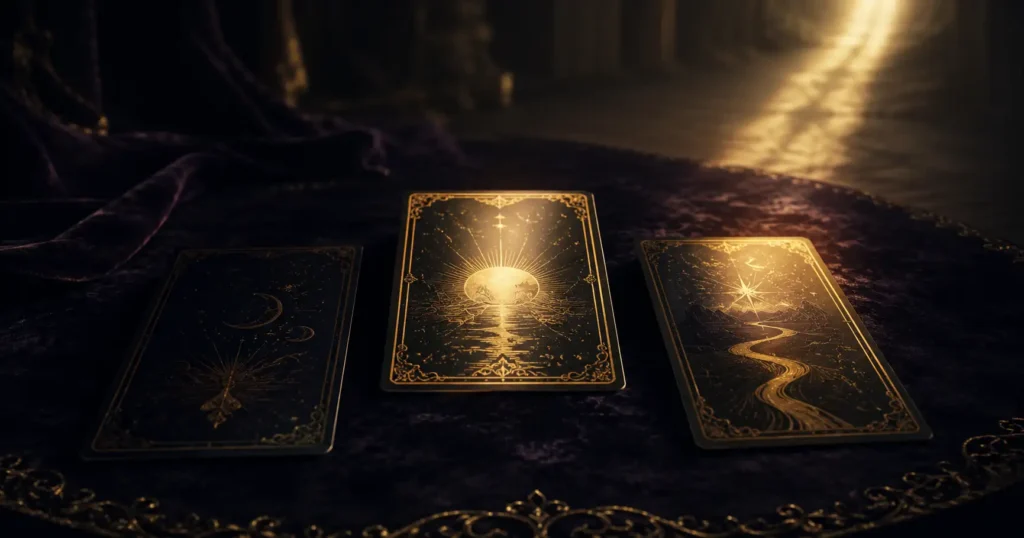
A tarot reading does not become deeper just because it uses more cards.
Sometimes, too many cards can make a reading feel impressive but confusing. The table fills with symbols, positions, possible meanings, and emotional noise. Instead of receiving clarity, you may leave with even more questions than you brought.
A focused three-card reading can do something different. It gives the mind enough structure to reflect, but not so much information that the central message disappears.
That is why PlayTarot begins with a three-card spread called The Inner Compass.
Three cards create movement
A single card can offer a powerful image. But three cards can create movement.
One card shows a symbol. Three cards can show a small journey: where you are stuck, what the situation is asking of you, and what action becomes possible when you see more clearly.
This is the difference between receiving a definition and entering a narrative.
In a reflective tarot reading, the goal is not to collect as many meanings as possible. The goal is to recognize the pattern that matters most right now.
The first card: what is hidden
The first card in The Inner Compass is The Blind Spot.
This position does not simply describe the past. It looks at what may be active beneath the surface now: a belief, fear, emotional habit, expectation, or hidden tension that is shaping the situation without being fully recognized.
This card can be uncomfortable, but not because it is negative. It is uncomfortable because it may point to something you have been walking around instead of looking at directly.
The Blind Spot asks:
- What am I not seeing clearly?
- What assumption may be guiding my reaction?
- What hidden pattern keeps repeating here?
Without this first card, a reading can stay too close to the surface. It may describe what you already know, but never reach the root.
The second card: what the moment asks of you
The second card is The Mirror.
In The Inner Compass, this is the card at the peak of the spread. It reflects the inner lesson, virtue, posture, or shift that the situation is asking from you.
This card is not about blaming yourself. It is about recovering your agency.
Instead of asking, “What will happen to me?”, The Mirror asks, “Who am I being invited to become in the way I meet this?”
Sometimes the answer is patience. Sometimes honesty. Sometimes courage, softness, discipline, surrender, or a more mature boundary.
The Mirror asks:
- What inner quality would help me meet this situation more consciously?
- What part of me is being challenged to grow?
- What response would feel more aligned than my automatic reaction?
This is where tarot becomes more than interpretation. It becomes self-recognition.
The third card: what you can do now
The third card is The Next Step.
This is one of the most important differences between reflective tarot and fatalistic tarot. The third card is not treated as a fixed future. It does not tell you what must happen next.
Instead, it points toward conscious movement.
Your next step may be practical, emotional, relational, or internal. It may be a conversation, a boundary, a pause, a decision, a question, a release, or a small act of courage.
The Next Step asks:
- What is within my influence now?
- What action would honor what I have just seen?
- What can I choose without pretending to control the whole outcome?
This final card gives the reading direction without taking away your freedom.
Why three cards can feel complete
The power of a three-card spread is that each card has a clear role.
The first card reveals what is hidden. The second card reflects what must be understood. The third card points toward what can be practiced.
Together, they form a complete reflective arc:
- The Blind Spot: what you could not see.
- The Mirror: what the moment asks of you.
- The Next Step: what you can consciously choose now.
This structure keeps the reading focused. It prevents the cards from becoming scattered messages and turns them into one connected story.
More cards are not always more clarity
Longer spreads can be valuable, especially for experienced readers. But for many people, a large spread can create too much symbolic information at once.
When every card seems important, it can become harder to know where to place your attention.
A three-card reading asks you to stay with the essential movement. It gives enough depth to reveal a pattern and enough simplicity to make the reading usable after the session ends.
The best reading is not the one that explains everything. It is the one that helps you see what matters and return to your life with more awareness.
A three-card reading is not shallow
Some beginners assume that three cards are only for quick readings. But a short structure can hold great depth when the positions are meaningful.
A poem can be shorter than a novel and still change the way you see something. A mirror can be small and still show the truth of a face.
The same is true here.
Three cards can be enough when each card is placed with purpose and interpreted as part of a living relationship.
How to bring a good question
The Inner Compass works best with questions that are open, honest, and present-focused.
Instead of asking:
“What will happen?”
Try asking:
- What am I not seeing about this situation?
- What is this moment asking me to understand?
- What conscious step is available now?
These questions do not deny uncertainty. They simply bring your attention back to the place where your awareness and choices still matter.
The reading ends where your authorship begins
A three-card tarot reading should not leave you dependent on the cards. It should help you return to yourself.
The cards reveal images. The spread gives those images a structure. The final reflection helps connect them. But the meaning is not complete until you meet it with your own honesty.
The card decides nothing. The spread does not choose your life. The reading opens a mirror.
Three cards can be enough when they help you see the hidden root, meet the inner lesson, and take one conscious step forward.
Try a three-card Inner Compass reading on PlayTarot
✨ Ready to explore your own reading? Visit PlayTarot, choose your deck, and begin your inner journey.
📌 Original Content Notice: This article was originally published on PlayTarot Blog . All rights reserved.
The reproduction, copying, or redistribution of this content, in whole or in part, without prior authorization is prohibited. Our articles are created with symbolic research, editorial care, and human review to support a deeper exploration of tarot, self-knowledge, and inner transformation.