
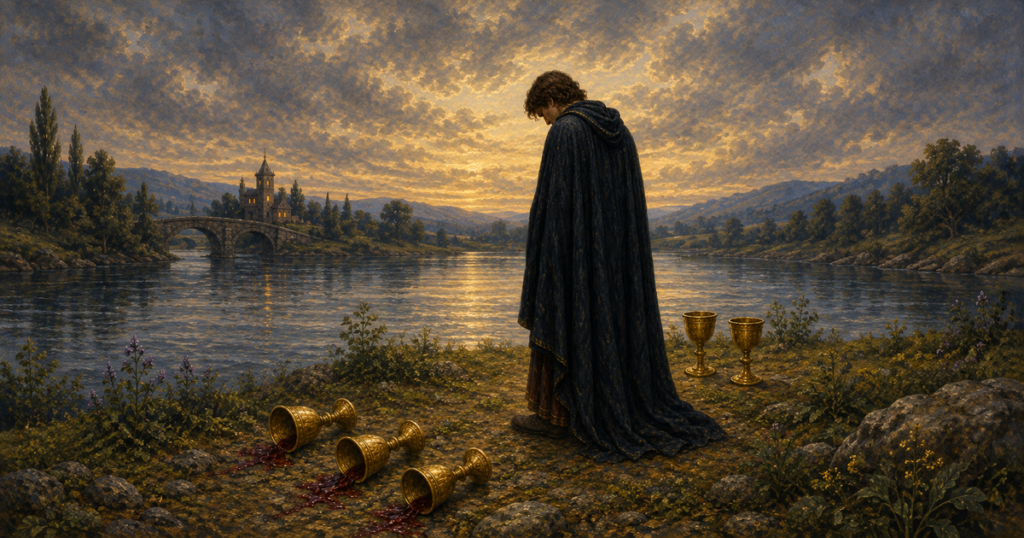
Three cups have spilled. Two are still standing. The whole card holds both truths at once: what is gone and what remains.
The Five of Cups offers one portrait of grief: attention held by what has spilled, while two cups remain outside the figure’s gaze. It does not assign a stage or timetable. It holds loss and what remains in the same landscape.
The classic root
A cloaked figure stands with head bowed over three fallen cups, their contents gone into the ground. The image gives loss the center of the frame. Behind the figure, two cups still stand. Further back are a river, a bridge, and a building on the opposite bank. These symbols do not cancel the loss or prove that the figure is ready to move. They keep another possibility in view: something remains, and the turn toward it cannot be forced.
The essence: grief before a changed landscape: what was lost is real, and what remains waits without demand.
Light: processing loss honestly, learning from pain, discovering what remains. Shadow: regret looping around the loss, guilt, and difficulty sensing support while grief fills the field.
Through the worlds
In the Inner Alchemy Tarot, this card becomes The Spilled Vessel: the flask overturned on the laboratory floor. What poured out will not return to the glass; that finality is respected, not softened. But a laboratory is a place of transformation: even spills become part of the record of the work. The question the deck asks is quiet: what remains on the bench?
In the Inner Forest Tarot, it becomes The Overturned Gourds: spilled vessels on the riverbank, while the river continues behind them. Loss and remaining water share the same image.
And in The Light Heart Tarot, it becomes The Spilled Cups (5 of the Lotus). Here the card joins the deck’s central story: grief that has not found room to be mourned can gain weight. The image allows mourning to be part of the movement toward a lighter heart.
In a reading
In The Blind Spot, this card may point to grief that is still shaping the mood before it has found words. In The Mirror, it gives the loss room to be mourned without demanding recovery. In The Next Step, it does not command a turn; it asks what support, memory, or remaining bond can be acknowledged when the time is right.
What deserves to be mourned, and what, without rushing you, is still here?
Let the cards name both sides of the river: draw the Inner Compass for what spilled, what remains, and where the bridge begins; the first reading is free. The full card map stays open in the 78-card glossary.
✨ Ready to explore your own reading? Visit PlayTarot, choose your deck, and begin your inner journey.
📌 Original Content Notice: This article was originally published on PlayTarot Blog. All rights reserved.
The reproduction, copying, or redistribution of this content, in whole or in part, without prior authorization is prohibited. Our articles are created with symbolic research, editorial care, and human review to support a deeper exploration of tarot, self-knowledge, and inner transformation.

